ATR 72-600 (Certified Variant: ATR 72-212A)
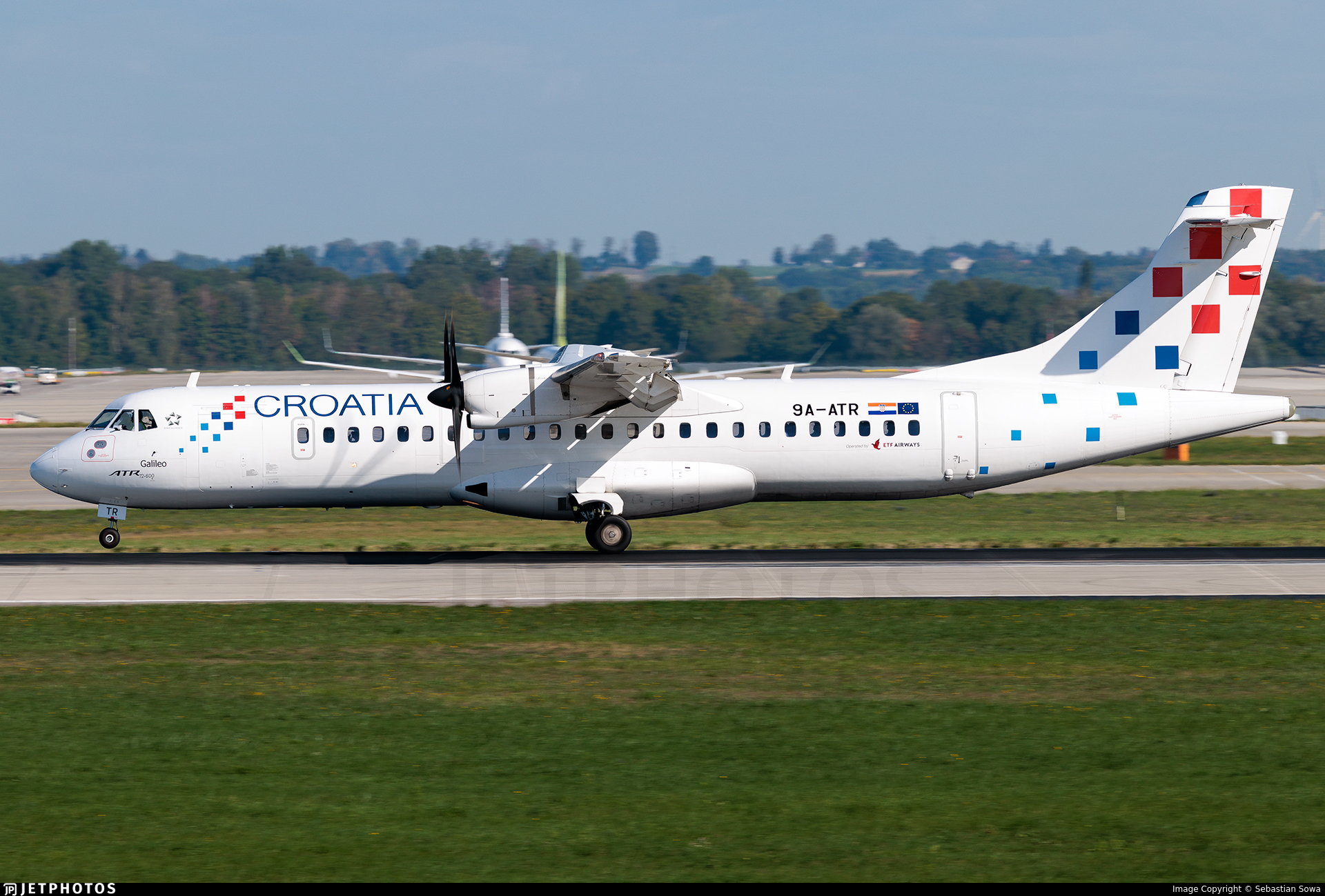
Operational Profile & Airframe Architecture
Built by Franco-Italian joint venture ATR (Airbus & Leonardo) in Toulouse, the ATR 72-600 is the dominant regional turboprop in European skies. It is heavily deployed on island-hopping networks (such as Binter Canarias in the Canary Islands), high-frequency domestic feeder routes (Air Nostrum / Iberia Regional and TAROM), and Baltic/Nordic regional sectors (SAS Link and Norra/Finnair).
The high-wing, T-tail layout protects the engines and propellers from Foreign Object Damage (FOD) on short regional strips. Primary wing box spar and skin panels incorporate carbon-fiber composite structures, while the unpressurized nose and tail cones house avionics and tailplane actuators.
Aircraft Systems, Avionics & Propulsion
- Thales Glass Flight Deck: Five 6×8-inch LCD displays (2 PFD, 2 ND, 1 EWD), dual Flight Management Systems (FMS) with RNP AR 0.3 capability, and a Multi-Purpose Computer (MPC) integrating centralized maintenance and Flight Warning System (FWS) functions.
- PW127M / PW127XT-M Powerplant: Two Pratt & Whitney Canada three-shaft free-turbine turboprops rated at 2,475 SHP normal takeoff power (and 2,750 SHP Reserve Takeoff Rating with Automatic Takeoff Power Control System — ATPCS). Drives 6-bladed Hamilton Standard 568F composite propellers with electronic governing (PPEC).
- RH Engine "Hotel Mode" (No APU): Instead of an Auxiliary Power Unit, the right-hand (#2) engine incorporates an electro-hydraulically actuated Propeller Brake (PROP BRK). When engaged on the ground with the gust lock on, the turbine runs as a gas generator to provide 28V DC electrical power and pneumatic bleed air for cabin conditioning while the propeller remains completely stationary.
- Hydraulic & Ice Protection Systems: Dual 3,000 psi hydraulic circuits (Blue and Green) pressurized by AC electric motor pumps. De-icing uses pneumatic Goodrich boots on wing and horizontal stabilizer leading edges, paired with an Automated Performance Monitoring (APM) system to detect severe ice accretion drag.
Detailed Technical Specifications
| Dimensions & Cabin | |
| Overall Length | 27.17 m (89 ft 2 in) |
|---|---|
| Wingspan | 27.05 m (88 ft 9 in) |
| Height | 7.65 m (25 ft 1 in) |
| Wing Area | 61.0 m² (656.6 sq ft) |
| Cabin Width | 2.57 m (8 ft 5 in) |
| Cabin Seating | 70–78 pax (4-abreast, 29–30" pitch) |
| Mass & Payload | |
| Operating Empty Weight | 13,500 kg (29,762 lb) |
| Max Takeoff Weight (MTOW) | 23,000 kg (50,706 lb) |
| Max Landing Weight (MLW) | 22,350 kg (49,273 lb) |
| Max Zero Fuel Weight | 21,000 kg (46,297 lb) |
| Max Payload | 7,500 kg (16,534 lb) |
| Max Fuel Capacity | 5,000 kg / 6,370 L (1,683 US gal) |
| Powerplant & Performance | |
| Engines | 2× P&WC PW127M / PW127XT-M |
| Propellers | 6-blade Hamilton Standard 568F (3.93 m) |
| Thermodynamic / TO Rating | 2× 2,750 SHP (2,051 kW) |
| Max Cruise Speed | 275 KTAS (510 km/h / Mach 0.44) |
| VMO / MMO | 250 KIAS / Mach 0.55 |
| Range (70 Pax) | 825 NM (1,528 km) |
| Service Ceiling | FL250 (25,000 ft / 7,620 m) |
| Takeoff Field Length | 1,315 m (4,314 ft) at ISA, MTOW |
| Landing Field Length | 915 m (3,002 ft) at MLW |